
Thursday, June 2, 2011

Sunday, March 13, 2011
$10 Kombucha Class

Hey FEASTers,
I am driving out to this Kombucha class. I have 4 spots in my car for anyone who wants to join me- email me (Suze Duggan: duggan@oxy.edu) by Wednesday the 16th to RSVP. The class in Hollywood and starts at 3:00, but I am leaving at 2:00.
Here is more info that was sent to me:
WHAT IS KOMBUCHA?
Kombucha is a fermented tea that has been used in China for medicinal purposes as early as the 19th century. When Kombucha is thoroughly and correctly fermented, it consists of acetic acid, carbonic acid, vitamins C, B1, B2, B3, B6, B12, B15, various beneficial enzymes and essential amino acids, folic acid, gluconic acid and lactic acid, as well as usnic acid—a natural product of fermentation, suppressing development of micro-organisms not belonging to the Kombucha culture.
ABOUT THE CLASS:
Do you want to feel comfortable brewing your own Kombucha Tea?
If you are not sure what to do with your Kombucha “mushroom” (SCOBY), come to Kombucha Class.
At the end of class, anyone who brings their own glass jar and wants to produce Kombucha Tea at home will be given a SCOBY for free.
Sunday, March 20, 3:00 to 4:30 p.m.
5 Topics will be presented to enable a person to feel comfortable making their own Kombucha Tea at home.
Topic 1: Brief history.
Topic 2: Common Kombucha Terms.
Topic 3: How to prepare and propagate Kombucha “mushroom” SCOBY and produce Kombucha Tea.
Continuous brewing and how to make your own SCOBY hotel.
How to flavor your tea.
Topic 4: Health Benefits.
Topic 5: Anti-aging topical uses for Kombucha Tea and SCOBY
SCOBY (Acronym standing for Symbiotic Colony of Bacteria and Yeast. This is the truest definition of a Kombucha Culture. Now you can impress your friends when you correct them and tell them it is not really a Mushroom!)
The Class is just $10 and everyone who brings their own glass jar and wants the Kombucha Culture (SCOBY) can take the starter home for free and start their own brew.
Friday, January 21, 2011
A tour of Gotreaux Family Farms

This is a re-post of an entry I wrote for the 2010/2011 Disaster Politics class blog from our time in New Orleans over winter break. I encourage everyone to visit it (http://oxyinneworleans.wordpress.com/), as well as the blog of Our School at Blair Grocery, an inspiring example of empowerment and food justice we also got to work with (http://schoolatblairgrocery.blogspot.com/)
Here is a brief look at Gotreaux Family Farms:
In a bit of a departure from our time at the Lower Ninth Ward Community Village, a group of us were fortunate to travel to Scott, LA to visit Gotreaux Family Farms, along with students from New York 2 New Orleans currently housed at Our School at Blair Grocery (OSBG).

This “green water” (caused by the color of the phyto plankton) then flows from the recycling pump tanks to human-made ditches that draw the nutrient rich water to the crop rows and the compost pile outside the tents that house the tilapia. Instead of waste water flowing back into potable water sources like those used in many conventional fish farms, the adjacent vegetable crops and soil are nourished organically.
It was hard to ignore the sound of hundreds of chickens roaming the acres of pasture across from the tilapia tanks and crop rows. Raised for nine and a half weeks, instead of the conventional four, the chickens are free to feed and stroll the 20 acres of pasture without restriction. For anyone who is familiar with Joel Salatin’s Polyface Farm (profiled in “The Omnivore’s Dilemma”, “Food Inc.” and “Fresh”), Gotreaux Farms uses an “eggmobile” to strategically transport the chickens to fresh grass.
Outside of the operational details of the farm, there is an important human side to the Gotreaux story. Bill Gotreaux, who runs the farm with his wife and 10 children, provided his explanation for starting the farm by stating that is was for purely health reasons. A career in the mechanical field had apparently given him dangerously high levels of chemicals, including arsenic. In short, he decided to raise his own organic food to save his life. This lifestyle change eventually became the farm we visited, but according to Mr. Gotreaux it has not been easy to create a food community embracing organic, fully sustainable foods that have historically been absent from the meat-centric diet that makes up Cajun cuisine: “This is Cajun country – they don’t eat vegetables.”

On a final note, there is an important connection to be made between the work of Gotreaux Family Farms and Our School at Blair Grocery. In a sense they are both trying to address food justice and community needs. For Gotreaux it is a wider food community that currently does not have the proper access to ‘good’, sustainable food (The vast majority of tilapia sales are to New Orleans-based vendors). For Our School, it is addressing youth empowerment through food justice in the Lower Ninth Ward. In both cases I believe that the government has failed to support the work being done. Bill Gotreaux detailed how the recently passed FDA Food Safety Modernization Act could effectively close down his operation due to increased regulation of smaller farms (http://www.huffingtonpost.com/alison-rose-levy/food-safety-why-food-safety-bi_b_795515.html). Government focus, however, has failed to address major food and education disparities in communities like the Lower Ninth. This is where Our School provides a unique space for a larger empowerment movement that has yet to be fully supported despite community involvement.
Wednesday, October 20, 2010
Trip to Pomona

Yesterday a group of nine FEASTers drove out to Pomona to take a look at their farm. We met with Professor Rick Hazlett, Professor Juan Araya and a few Pomona students and alum. Overall it was incredibly inspirational and I can definitely foresee some joint events between our two operations.
The Environmental Analysis program at Pomona has provided a tremendous amount of institutional support for the gardening/farming movement on campus that started as a guerilla garden in the late 1990s. Since then, sustainable agriculture has found its place in the Environmental Analysis curriculum. As with any movement for change, they have experienced administrative road blocks but over time their efforts have materialized. Integrating sustainable agriculture or agroecology into the academic curriculum is a wonderful way to lend legitimacy to a student-run garden. Hopefully we can achieve that here at Oxy in the next year or two. I had an amazing time touring their farm and hearing about the challenges they have faced and overcome. Check out pictures on Facebook and Picasa.
Monday, October 18, 2010
The Farmer and The Cook

 I went on the Sustainability retreat organized by the Office of Religious and Spiritual Life this weekend for Fall Break. Overall it was an amazing experience and I think everyone had a great time. We left early on Saturday and drove to Ojai where we met Steve Sprinkel and Olivia Chase. Together they run an organic farm, CSA, grocery store and restaurant as the farmer and the cook respectively. We worked with Steve at the farm for most of Saturday, picking pumpkins, brussel sprouts, carrots, potatoes and beans. Then we stopped by the Ojai festival and finished with a fabulous meal at their restaurant. We even ate the potatoes we had picked. I had an eggplant, squash and pumpkin tagine with polenta and we all had amazing chocolate cake for dessert. Here is their website if you are interested!
We spent the night at a campground close by and had a long conversation around the campfire that touched on a variety of topics but most notably sustainability, spirituality, the importance of food and what a great day it had been. On Sunday, after a lazy morning at the campground we packed up and went to local hot springs to eat lunch and take a dip before the drive back to campus.
Wednesday, October 6, 2010
Tomorrow and Upcoming Events!
Hi Everyone,
We'll be meeting in the garden tomorrow for the usual activities around 5 pm. There might even be some hot cocoa so bring a mug!!
On Friday, October 8th, author Katherine Leiner will be giving a presentation from 1 to 2 pm in the Morrison Lounge. Her book, Growing Roots, profiles young leaders in the sustainable food movement. You shouldn't miss this!
I am arranging a get together with Rick Hazlett, a professor at Pomona who teaches their Farms and Gardens class, and probably some Pomona students who are involved with their farm. It will be on Tuesday, October 19th. It is the Tuesday of Fall Break. We will either meet here at Oxy or go to Pomona and see their operation. Please let me know if you are interested in participating in this!
This Sunday is CicLAvia; it's a 7.5 mile route through the streets of LA, which will be only open for BIKES! Giulia is leaving from the garden at 10 am and anyone who wants to go should bring $1.50 for the train, a bike and some water. The whole thing should take about 2.5 hours. If you don't have a bike, check one out from the BikeShare in the LIBRARY!
Lastly, Tour De Fat is on Saturday, October 23. It is a bike, beer and music festival sponsored by the New Belgium Brewery. If we can get some people to volunteer to help with the "take down" of the event from 5 to 7 pm (tables, tents, clean up, etc), we can make some money for FEAST! As a volunteer, you'll get a free t-shirt and a beer token (if you're 21 or over)! This will be in the Historic Downtown LA Park. Let me know ASAP if you are interested!
We'll be meeting in the garden tomorrow for the usual activities around 5 pm. There might even be some hot cocoa so bring a mug!!
On Friday, October 8th, author Katherine Leiner will be giving a presentation from 1 to 2 pm in the Morrison Lounge. Her book, Growing Roots, profiles young leaders in the sustainable food movement. You shouldn't miss this!
I am arranging a get together with Rick Hazlett, a professor at Pomona who teaches their Farms and Gardens class, and probably some Pomona students who are involved with their farm. It will be on Tuesday, October 19th. It is the Tuesday of Fall Break. We will either meet here at Oxy or go to Pomona and see their operation. Please let me know if you are interested in participating in this!
This Sunday is CicLAvia; it's a 7.5 mile route through the streets of LA, which will be only open for BIKES! Giulia is leaving from the garden at 10 am and anyone who wants to go should bring $1.50 for the train, a bike and some water. The whole thing should take about 2.5 hours. If you don't have a bike, check one out from the BikeShare in the LIBRARY!
Lastly, Tour De Fat is on Saturday, October 23. It is a bike, beer and music festival sponsored by the New Belgium Brewery. If we can get some people to volunteer to help with the "take down" of the event from 5 to 7 pm (tables, tents, clean up, etc), we can make some money for FEAST! As a volunteer, you'll get a free t-shirt and a beer token (if you're 21 or over)! This will be in the Historic Downtown LA Park. Let me know ASAP if you are interested!
Monday, October 4, 2010
KATHERINE LEINER
Come hear Katherine Leiner, author of Growing Roots, this Friday, October 8th, from 1 to 2 pm in the Morrison Lounge. Her book profiles some of the young pioneers in the sustainable food movement and more importantly shares some of their recipes. Hope to see you all there!


Tuesday, September 28, 2010
Usual Thursday + POTLUCK!
Hey all,
I hope everyone is doing well!
We will be meeting in the garden this Thursday at our usual time, 5 pm. After planting, preparing beds, tending to the chickens and turning/building our compost piles there will be a POTLUCK IN THE GARDEN (around 6 pm)! We're hosting this with WellFed so you may have already received an email but please come and bring something yummy! Don't forget a plate, silverware and a cup!
See you all there!
I hope everyone is doing well!
We will be meeting in the garden this Thursday at our usual time, 5 pm. After planting, preparing beds, tending to the chickens and turning/building our compost piles there will be a POTLUCK IN THE GARDEN (around 6 pm)! We're hosting this with WellFed so you may have already received an email but please come and bring something yummy! Don't forget a plate, silverware and a cup!
See you all there!
Wednesday, September 8, 2010
Voting and Doodle Poll
Hello Everyone,
We had our first meeting in the garden on Thursday and it was great to see so many old and new faces. This coming Thursday will be an important meeting so try to be there starting around 5 pm! I will explain the club constitution and then we will vote on it. I will have met with Rebecca Dowling (risk management), and give you all an update on our efforts to start a farm cart or get produce into the Market Place. Furthermore, we will be solidifying the positions on the Executive Board for the semester.
IMPORTANT: everyone who wants to have a leadership position please email and tell me which one(s) your interested in. Email even if you already have a position because I want to take stock.
In addition to our weekly meetings on Thursdays, here is a Doodle poll that will develop a rotating schedule of daily duties. These will include irrigating the beds, collecting eggs, checking the food and water for the chickens and letting them out of the coop for a bit. This commitment will realistically take at a bare minimum 30 minutes and probably closer to an hour. It should ideally be done sometime in the morning. Even if you can't come to our Thursday gardening times please feel free to sign up for this! In payment, you are free to take some of eggs for personal use! We will go over the details once a schedule is set up.
See you soon
We had our first meeting in the garden on Thursday and it was great to see so many old and new faces. This coming Thursday will be an important meeting so try to be there starting around 5 pm! I will explain the club constitution and then we will vote on it. I will have met with Rebecca Dowling (risk management), and give you all an update on our efforts to start a farm cart or get produce into the Market Place. Furthermore, we will be solidifying the positions on the Executive Board for the semester.
IMPORTANT: everyone who wants to have a leadership position please email and tell me which one(s) your interested in. Email even if you already have a position because I want to take stock.
In addition to our weekly meetings on Thursdays, here is a Doodle poll that will develop a rotating schedule of daily duties. These will include irrigating the beds, collecting eggs, checking the food and water for the chickens and letting them out of the coop for a bit. This commitment will realistically take at a bare minimum 30 minutes and probably closer to an hour. It should ideally be done sometime in the morning. Even if you can't come to our Thursday gardening times please feel free to sign up for this! In payment, you are free to take some of eggs for personal use! We will go over the details once a schedule is set up.
See you soon
Tuesday, August 3, 2010
Fruit Trees
The principle that function follows form holds true for the pruning and training of fruit trees. The geometry that a pruner encourage is purposeful and dictates the growth pattern of a tree. There are generally two different pruning methods: modified central leader and open-centered. We learned about the former and not the latter although both are in practice. This description will pertain to all temperate zone, deciduous fruit trees, excluding citrus, guavas, etc. that are grown on dwarf or semi-dwarf rootstalks. This included apples, pears, peaches, nectarines, plums, etc. The overall tree structure, when viewed from afar, should resemble a cone or isosceles triangle. This will allow for maximum light penetration. Since dwarf or semi-dwarf fruit trees are generally fairly short (10 to 15 feet tall), there will be two tiers of fruit producing braches. From the main trunk, central leader, primary branches radiate out in all directions and ideally the first tier should have 5 to 9 branches. There should be a 1 to 3 foot gap on the trunk between the highest first tier primary and the lowest second tier primary branches. The second tier should have similarly radiating primary branches from the trunk. These main branches are the primary scaffold of the tree and each has multiple lateral and sub-lateral branches. It is important that lateral branches are perpendicular and not parallel to the primary branch. When primary branches are vertical hormones and resources encourage rapid, upward vegetative growth and not fruit production. Furthermore, these will compete with the primary leader. Therefore, weights or ties with stakes can be used to direct both verticality and radial direction of growth. Primary branches should growth at a 45º to 75º angle from the trunk. Fruit trees, when young, are incredibly malleable and branches can be cut and trained to conform to a certain geometry.
For temperate, deciduous fruit trees, only two or more year old wood will produce any fruit, unlike evergreen trees that bear on terminal growth. Shortening cuts can be used to trim branches back to fruit buds on older growth. Cutting branches during fruit production but before the third week of July (approximately) will encourage fruit production and not vegetative growth the following year. However, pruning the winter time encourages growth, therefore it is important to trim unwanted growth during the summer and wanted growth during the winter.
For temperate, deciduous fruit trees, only two or more year old wood will produce any fruit, unlike evergreen trees that bear on terminal growth. Shortening cuts can be used to trim branches back to fruit buds on older growth. Cutting branches during fruit production but before the third week of July (approximately) will encourage fruit production and not vegetative growth the following year. However, pruning the winter time encourages growth, therefore it is important to trim unwanted growth during the summer and wanted growth during the winter.


Friday, July 30, 2010
Gio's Summer in Santa Cruz
Yesterday I had the chance to visit Santa Cruz and sit in on Gio's class at the Santa Cruz Center for Agrobiology. In the three short hours I was in class I learned SO MUCH! I can only imagine the wealth of knowledge that Gio is going to bring back to FEAST this fall. The farm itself is spectacular! If you are going to be in/around Santa Cruz at all in the next few weeks I recommend trying to get a tour of the farm from Gio. It is on the top of a hill with incredible views of the ocean and the produce is beautiful-- fruit trees everywhere plus every flower and vegetable you could imagine. We spent some walking through the Chadwick garden which is the first garden that Santa Cruz built and seems to be one of the birthplaces of alternative farming in California. The peach trees were heavy with fruit (we got to eat some of the fallen ripe ones :)) and the pear and apple trees are already so overloaded I don't know how they are going to stay standing until fall!
I wish I had brought my camera along but I guess you'll just have to go see for yourselves!
Thursday, July 29, 2010
The Agro-Food System
Here is an interview with Raj Patel that showcases his perspective on the problems that we currently face in regards to food, hunger and sustainability. Raj recently released The Value of Nothing which is one of my favorite books. He has done a lot of work with Food First and the Via Campesina movement. Here's a link to his website.
Hope you enjoy!
Hope you enjoy!
Tuesday, July 27, 2010
Propagation
Propagation is one of the most important aspects of a successful agricultural endeavor. A grower must decide whether to direct seed or transplant a crop. All root crops or ones that have taproots are usually direct seeded while others are commonly transplanted in smaller operations. At the Chadwick, or Up-, Garden at UCSC about 80-85% of the crops are transplanted, a practice that can be used to extend the growing season and ensure a specific crop density in the beds. However, transplants require the additional costs of building and maintaining a greenhouse facility and the extra labor that goes into the process of transplanting. Typically, two different types of trays are used: wooden flats and plug trays (often the Speedling brand). Each method has its own pros and cons. Wooden flats fit many more plants in a small area but require more skill for transplanting and starts can also be kept for a longer period of time in wooden flats before transplanting if environmental conditions are not favorable to transplanting (8 or 9 weeks). Starts from plug trays are much easier to transplant but with limited nutrients the starts must be transplanted within 5 to 6 weeks after planting. Furthermore, there are compaction issues as the soil begins to lose pore space and nutrients. Some varieties of plants simply grow better in one type of tray while others do well in both. The Up-Garden uses more flats in the spring and more plug trays in the summer. Starts can generally be transplanted once they have 6 to 8 leaves but before doing so trays are placed on outside benches for a few days to strengthen cell walls with wind movement and to “harden them off” to the conditions outdoors. This will minimize transplant shock and ensure successful transplanting.
One of the most important aspects of propagation for starts is the potting mixture used in the plug trays or wooden flats. The soil media must physically anchor the plant and provide adequate drainage properties to reduce fungal disease but retain moisture and encourage gas exchange in the pore space. Furthermore, when growing in a greenhouse, the environment is incredibly conducive to growth of all kinds, including diseases and pests. For this reason, some propagators believe in using a sterile mix; simply heating soil to 130ºF for at least 4 hours should kill all of the detrimental seeds, pathogens, pests and diseases but still maintain some beneficials while if the soil reaches around 180/190ºF it is pretty much sterile and not biologically active. At the CASFS farm, they believe in biologically active soil mixtures and are conscientious about trying to utilize local and renewable components. Peat moss is quite common in potting mixes but it is a slow growing resource in the Northern latitudes that is being quickly degraded. Their mixture is primarily soil and compost based, but it includes coconut husks, vermiculite, leaf mold (leaf compost), perlite, sand and sometimes fish, blood or bone meal.
In controlling for pests, pathogens and diseases, it is important to keep greenhouses clean, encourage good air flow through the site, avoid contamination, deal with any outbreaks quickly and aim for idealized soil structure, which is 50% air by volume. Roots grow in the pore space (air content) of soil so it is important that soil structure supports good, even pore space. This pore space should be 50% water and 50% air.
One of the most important aspects of propagation for starts is the potting mixture used in the plug trays or wooden flats. The soil media must physically anchor the plant and provide adequate drainage properties to reduce fungal disease but retain moisture and encourage gas exchange in the pore space. Furthermore, when growing in a greenhouse, the environment is incredibly conducive to growth of all kinds, including diseases and pests. For this reason, some propagators believe in using a sterile mix; simply heating soil to 130ºF for at least 4 hours should kill all of the detrimental seeds, pathogens, pests and diseases but still maintain some beneficials while if the soil reaches around 180/190ºF it is pretty much sterile and not biologically active. At the CASFS farm, they believe in biologically active soil mixtures and are conscientious about trying to utilize local and renewable components. Peat moss is quite common in potting mixes but it is a slow growing resource in the Northern latitudes that is being quickly degraded. Their mixture is primarily soil and compost based, but it includes coconut husks, vermiculite, leaf mold (leaf compost), perlite, sand and sometimes fish, blood or bone meal.
In controlling for pests, pathogens and diseases, it is important to keep greenhouses clean, encourage good air flow through the site, avoid contamination, deal with any outbreaks quickly and aim for idealized soil structure, which is 50% air by volume. Roots grow in the pore space (air content) of soil so it is important that soil structure supports good, even pore space. This pore space should be 50% water and 50% air.
Monday, July 26, 2010
Organic Certification
We heard about the organic certification process and standards from Amy Lamendella, an inspector for California Certified Organic Farmers (CCOF). It was enlightening to hear what is regulated under the 2002 National Organic Program. Certification involves a lot of paperwork, documents and receipts; Amy described it as the process by which farmers document their practices and turn a physical enterprise into a verbal description. The National Organic Program is part of the USDA and a certification branch deals with all of the third-party labeling organizations. The USDA does not actually do any organic certifying, that is done by organizations like CCOF, Oregon Tilth, or QAI. Instead, the USDA is the overseer.
Contrary to popular belief, organic does not mean that pesticides are not used. Basically, synthetic substances are not allowed in organic agriculture unless specifically approved under the National Organic Program and all naturally occurring substances are allowed unless specifically prohibited. As a result, some natural and synthetic pesticides are still used in organic agriculture. However, farmers must document pest management strategies and show evidence that previous methods have failed before they are allowed to use some of the stronger pesticides.
Organic farms must purchase organic seed, if available, for both food crops and cover crops. Furthermore, soil organic matter must be maintained or improved under organic management. However, the National Organic Program does not regulate labor practices; inspectors turn a blind eye to illegal labor conditions and practices since it is not part of their protocol.
The organic program also has strict regulations for compost, specifically for piles that contain animal material. For organic certification of compost piles with manure, egg shells, or other animal products, piles must reach and maintain a temperature between 131ºF and 170ºF for 15 days and be turned at least 5 times during that period. However, if the compost is going to be applied to a field that will not have crops harvested from it for more than 120 days these requirements are not necessary. The certification of organic compost is incredibly important for farms that make and use their own compost. The piles at the CASFS farm at UCSC are tested to make sure that they meet the standards.
When farms seek organic certification, there is a three year transition period from the last application of prohibited substances. During this time, it can be hard to survive economically since conventional practices are prohibited but produce still can’t garner the organic price premium. One of the most interesting things is that if gross annual sales are not more than $5,000, growers must register as organic with the state but are not required to be certified. In other words, if our on-campus garden registers, our produce can be sold as organic as long as we adhere to the organic standards without having to pay for third-party certification.
Contrary to popular belief, organic does not mean that pesticides are not used. Basically, synthetic substances are not allowed in organic agriculture unless specifically approved under the National Organic Program and all naturally occurring substances are allowed unless specifically prohibited. As a result, some natural and synthetic pesticides are still used in organic agriculture. However, farmers must document pest management strategies and show evidence that previous methods have failed before they are allowed to use some of the stronger pesticides.
Organic farms must purchase organic seed, if available, for both food crops and cover crops. Furthermore, soil organic matter must be maintained or improved under organic management. However, the National Organic Program does not regulate labor practices; inspectors turn a blind eye to illegal labor conditions and practices since it is not part of their protocol.
The organic program also has strict regulations for compost, specifically for piles that contain animal material. For organic certification of compost piles with manure, egg shells, or other animal products, piles must reach and maintain a temperature between 131ºF and 170ºF for 15 days and be turned at least 5 times during that period. However, if the compost is going to be applied to a field that will not have crops harvested from it for more than 120 days these requirements are not necessary. The certification of organic compost is incredibly important for farms that make and use their own compost. The piles at the CASFS farm at UCSC are tested to make sure that they meet the standards.
When farms seek organic certification, there is a three year transition period from the last application of prohibited substances. During this time, it can be hard to survive economically since conventional practices are prohibited but produce still can’t garner the organic price premium. One of the most interesting things is that if gross annual sales are not more than $5,000, growers must register as organic with the state but are not required to be certified. In other words, if our on-campus garden registers, our produce can be sold as organic as long as we adhere to the organic standards without having to pay for third-party certification.
Agroecology Practicum, UCSC
This summer I wanted to learn more about gardening and agriculture in general, basically how to grow things! Early last semester I thought about interning on a farm or finding a summer educational program to take. Through both internet research and word of mouth I found the Agroecology Practicum at UC Santa Cruz. It is part of the Environmental Studies department and it is a summer course that counts for upper division credit. There are two sessions of the class; each one is five weeks long. The curriculum is a mixture of both hands-on work, in the gardens and on the farm, and classroom-based discussions and lectures. As students, we get integrated for work in the fields with the farm apprentices, who are taking a 6-month apprenticeship program that focuses on all aspects of organic farm management. The apprenticeship program seems amazing; most of the 37 or so apprentices live communally in these tent cabins and they learn about organic farming while operating this amazing on-campus educational farm. About 7 get paid to stay for a second year to help run the program. The farm is part of CASFS, the Center for Agroecology and Sustainable Food Systems. UCSC is one of only a few schools to have such a strong program in agroecology, which is basically the intersection of agronomy and ecology. It seeks to integrate ecological principles and phenomena with the goal of improving agricultural practices to increase yields, minimize environmental degradation, promote land stewardship and achieve long-term sustainability. I highly recommend taking the practicum and seeking other educational offerings in agroecology.
I will follow this post with others about specific topics that we've talked about in class. We've covered a ton of material so far and some of it is hard to explain without visual aids and hands-on experience but I'll try. Feel free to ask for any clarification!
I will follow this post with others about specific topics that we've talked about in class. We've covered a ton of material so far and some of it is hard to explain without visual aids and hands-on experience but I'll try. Feel free to ask for any clarification!
Sunday, July 25, 2010
A LOT of exciting news
For all of those who read this:
THE CHICKENS ARE LAYING EGGS!!!

We got the news last Monday night: Mat found the first egg, barely larger than a quarter. I still have to ask him/compare the egg to the other eggs to figure out who was the very first. We are all really excited and tonight I am making poached eggs on toast with mustard and garlic chard and swiss cheese.
In other news, there are tomatoes, corn, eggplant, melons (just starting to ripen), more summer squash, and we have one VERY large potato plant.
Here are three pictures of my dinner last night, mostly all from the garden:
Basil*, tomato*, eggplant*, zucchini* linguine with fresh Mozarella

and Corn* salad with cilantro*

THE CHICKENS ARE LAYING EGGS!!!
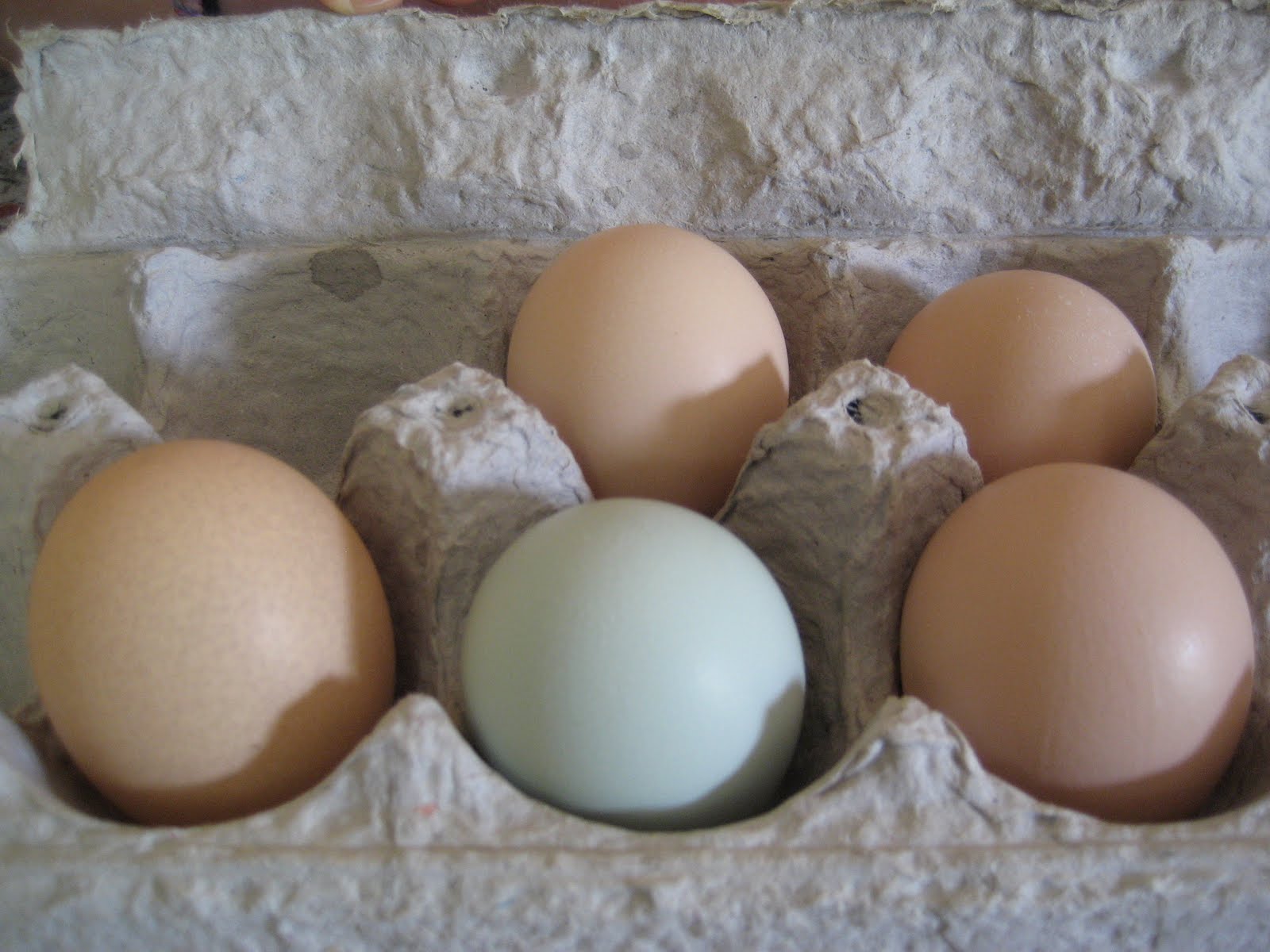
We got the news last Monday night: Mat found the first egg, barely larger than a quarter. I still have to ask him/compare the egg to the other eggs to figure out who was the very first. We are all really excited and tonight I am making poached eggs on toast with mustard and garlic chard and swiss cheese.
In other news, there are tomatoes, corn, eggplant, melons (just starting to ripen), more summer squash, and we have one VERY large potato plant.
Here are three pictures of my dinner last night, mostly all from the garden:
Basil*, tomato*, eggplant*, zucchini* linguine with fresh Mozarella


and Corn* salad with cilantro*

Sunday, July 18, 2010
Video
Sorry I don't know how to embed videos...but you should watch this! Emily sent it to me. Its about the relationship between climate change and agriculture around the world as well as the food system's impact on the climate. Check it out. If any of you know how to embed videos please repost this is a sexier way (and then tell me how you did it).
Monday, July 5, 2010
Hey Everyone!
I know it's been a LOOOOONNNGG time since we last posted, so here is an update on the garden. We have three summer garden managers Mat, Taylor, and Nick who keep the garden running. The chickens are great (we expect them to lay in the next month). We have corn AND Potatoes AND Eggplant. Instead of telling you what is happening in the garden, I'll just show you.
Ronde Nice Summer Squash (our biggest crop this year)


I know it's been a LOOOOONNNGG time since we last posted, so here is an update on the garden. We have three summer garden managers Mat, Taylor, and Nick who keep the garden running. The chickens are great (we expect them to lay in the next month). We have corn AND Potatoes AND Eggplant. Instead of telling you what is happening in the garden, I'll just show you.
Ronde Nice Summer Squash (our biggest crop this year)


Subscribe to:
Posts (Atom)